
Fuse Box Replacement Cost Toronto & GTA | 2026 Guide

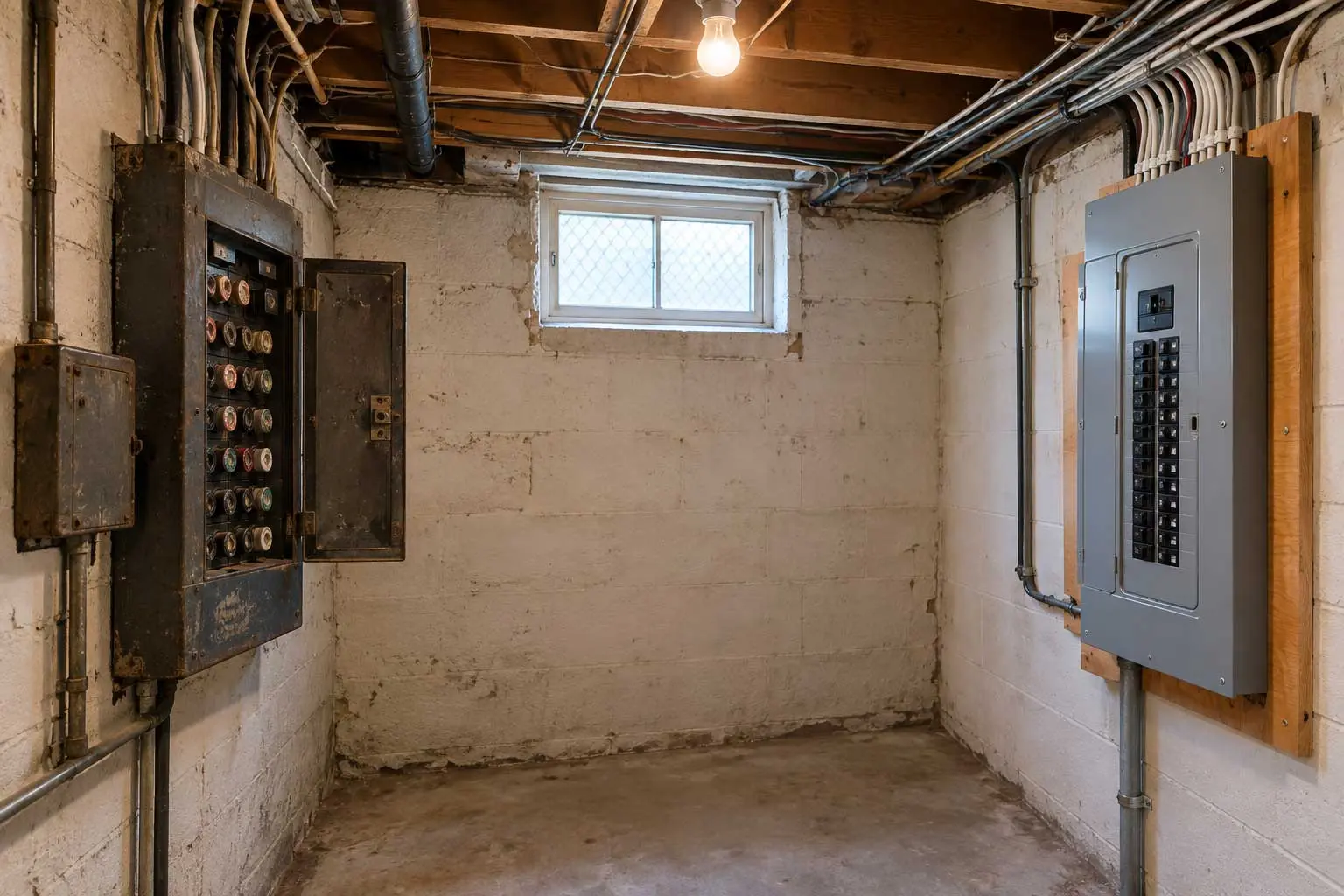
If your Toronto or GTA home still has an older fuse box, you may be wondering about the fuse box replacement cost and how much it will cost to replace it with a modern breaker panel.
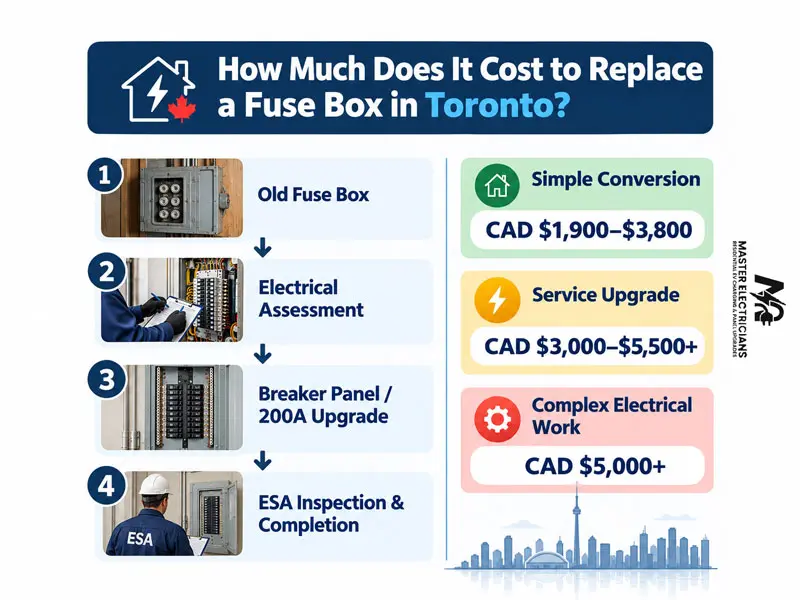
For a straightforward fuse box-to-breaker-panel conversion, homeowners can generally expect to budget around CAD $1,900–$3,800. If the existing electrical service also needs to be upgraded—for example, from an older 60-amp or 100-amp service to 200 amps—the total can commonly reach CAD $3,000–$5,500+, with more complex projects costing more. Current 2026 Toronto-area pricing sources show a wide range because some projects are simple panel replacements while others involve a complete service upgrade.
However, the final price depends on whether you are replacing only the fuse box or upgrading the home’s electrical service at the same time.
All prices in this article are in Canadian dollars (CAD).
The important thing is to understand which type of project your home actually needs. Replacing the fuse box alone is very different from upgrading the entire electrical service.
How Much Does It Cost to Replace a Fuse Box with a Breaker Panel?
There is no single price for every Toronto or GTA home.
In general, a straightforward fuse box replacement cost less than a full electrical service upgrade.
A useful starting point for budgeting is:
| Type of Electrical Work | Typical Cost Range (CAD) |
| Simple fuse box → breaker panel conversion | $1,900–$3,800 |
| Fuse box → 200A breaker panel | $2,500–$5,500+ |
| 60A → 200A service upgrade | $3,000–$5,500+ |
| 100A → 200A service upgrade | $2,500–$4,500+ |
| Panel relocation | $800–$1,500+ |
| Additional rewiring | Varies by scope |
| Major service or electrical upgrades | $5,000+ |
However, projects that require a service upgrade, panel relocation, rewiring, or other electrical work can cost considerably more.
These are planning ranges, not guaranteed quotes. Current Toronto/GTA sources report fuse-to-breaker conversions around $1,900–$5,800, while more extensive 100A-to-200A upgrades are commonly reported in the $2,500–$4,500+ range.
The final cost depends heavily on the existing service size, condition of the wiring, panel location, grounding, utility connection and whether you are simply replacing the panel or increasing the home’s electrical capacity.
Fuse Box Replacement vs. Electrical Service Upgrade
First, it is important to understand the difference between replacing a fuse box and upgrading the electrical service.
In contrast, a service upgrade may involve the meter base, service entrance, grounding, utility coordination, and other components.
This distinction is one of the most important things to understand before comparing quotes.
Option 1: Replace the Fuse Box
In a simple conversion, the existing electrical service may have enough capacity and the main objective is to replace the outdated fuse equipment with a modern breaker panel.
This can be the least expensive option.
A current 2026 Toronto-area estimate for a simple fuse box-to-breaker conversion is approximately CAD $1,900–$3,800, depending on the existing setup and scope of work.
Option 2: Upgrade the Electrical Service
An older home may have a 60A or 100A service that is no longer suitable for its electrical needs.
In that situation, the project may involve much more than replacing the panel.
It could require:
- New service conductors
- New meter base
- Service mast or weatherhead
- Grounding upgrades
- New 200A panel
- Utility coordination
- Additional electrical work
- ESA notification and inspection
That is why a complete service upgrade can cost substantially more than a simple panel replacement.
Current GTA pricing sources put many 100A-to-200A projects in the CAD $2,500–$5,800+ range depending on the property and scope.
What Is Included in the Cost?
A professional quote may include several different components.
Breaker Panel
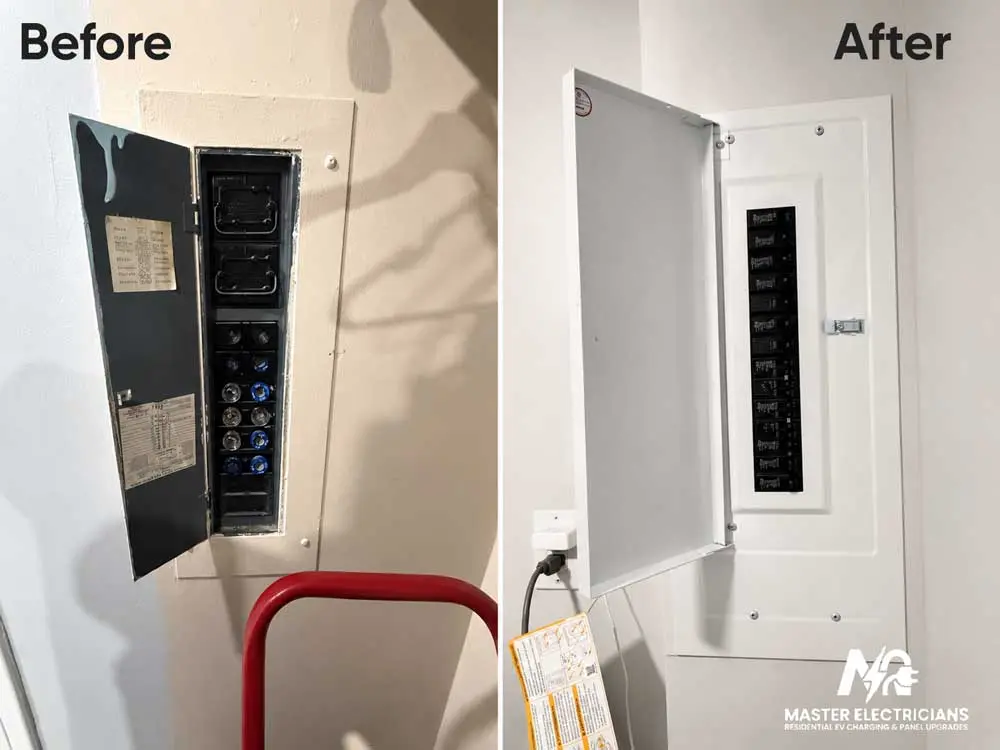
The new breaker panel becomes the central distribution point for the home’s electrical circuits.
The size and configuration depend on the electrical service and the home’s requirements.
For many modern homes, a 200A panel provides considerably more flexibility than the older fuse systems commonly found in older properties.
However, installing a 200A panel does not automatically mean the entire electrical service is 200A.
The service conductors and other components must also be capable of supporting the selected capacity.
Breakers and Electrical Components
The project may require:
- Main breaker
- Branch circuit breakers
- Grounding and bonding components
- Connectors
- Conductors
- Panel hardware
- Labelling
- Other code-required components
The exact materials depend on the existing installation.
Labour
Labour covers the electrician’s work to:
- Assess the existing system.
- Disconnect the existing equipment.
- Remove the fuse box.
- Install the breaker panel.
- Reconnect the circuits.
- Make required electrical corrections.
- Test the system.
- Complete the required ESA process.
A straightforward replacement can be relatively quick.
A 60A-to-200A service upgrade is a much larger project.
ESA Notification and Inspection
Electrical work in Ontario must comply with the Ontario Electrical Safety Code.
When you hire an electrical contractor for this type of work, the contractor should handle the required ESA notification and inspection process.
ESA states that electrical work should be performed by a Licensed Electrical Contractor (LEC) when hiring a contractor, and electrical work must be reported to ESA through the required notification process.
The exact ESA fee depends on the type and scope of work. ESA’s published fee schedule should be used for the current applicable charge rather than assuming a fixed “permit price.”
After the work is accepted, homeowners should keep the Certificate of Acceptance with their home records.
Utility Coordination
A larger service upgrade may require coordination with the electrical utility.
This can involve:
- Scheduling the power disconnect.
- Making the electrical installation safe.
- Completing the service upgrade.
- Coordinating reconnection.
- Completing required inspection steps.
- Restoring electrical service.
This is another reason why a complete service upgrade costs more than simply changing the panel.
The exact process and utility charges can depend on the property and service configuration.
What Affects the Cost of Replacing a Fuse Box?
Several factors can affect the final price. For example, the existing service size and condition of the wiring can make a significant difference.
In addition, the distance between the electrical equipment and other components can increase labour and material costs.
1. Existing Service Size
This is one of the first things an electrician should determine.
A home with a 100A service may have a relatively straightforward path to modernization.
A home with an older 60A service may require considerably more work if the homeowner wants 200A service.
Current Toronto pricing sources place 60A-to-200A projects above many straightforward panel replacements because the service entrance and related components may need to be replaced.
2. Electrical Panel Capacity
A common question is:
“Do I really need 200 amps?”
Not necessarily.
The appropriate service size depends on the home’s electrical demand and future plans.
A homeowner planning to add:
- EV charging
- Heat pump
- Central air conditioning
- Hot tub
- Finished basement
- Home addition
- Workshop
- Electric appliances
may need more electrical capacity than a smaller home with fewer electrical loads.
A proper load assessment is more useful than simply choosing the largest panel available.
Do You Need to Upgrade to 200 Amps?
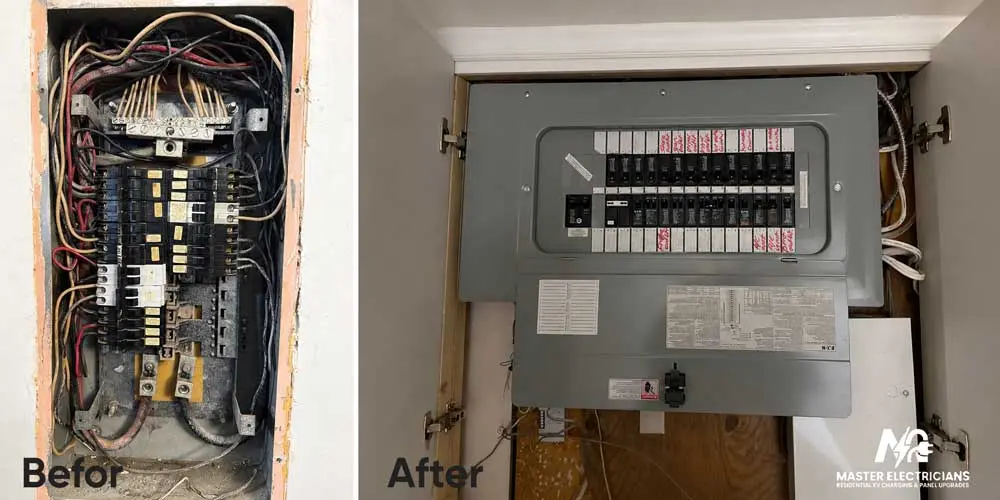
Replacing the fuse box does not automatically mean upgrading to 200A service.
You may have two separate decisions:
Decision 1: Do you need to replace the old fuse equipment?
Decision 2: Does your home need additional electrical capacity?
If the existing service is adequate, a panel replacement may be enough.
If the home has an older 60A or 100A service and your electrical demand has increased significantly, a service electrical panel upgrades may make more sense.
For example, adding an EV charger to an older home may trigger the need to evaluate the existing service capacity before EV charger installation.
This is why the electrical assessment should come before choosing the final panel size.
How Much Does a 60A to 200A Upgrade Cost?
For example, many older homes with 60-amp service may require more than a simple panel replacement.
If you are upgrading from 60A to 200A, the project can involve:
- New 200A breaker panel
- New service entrance conductors
- Meter base
- Service mast/weatherhead where applicable
- Grounding and bonding
- Utility coordination
- ESA notification and inspection
- Labour
A reasonable 2026 planning range is approximately CAD $3,000–$5,500+, although difficult installations can cost more. Current Toronto sources place 60A-to-200A projects around $3,000–$5,500, while other estimates put them around $3,500–$6,000 depending on the service configuration.
The key point is that this is a service upgrade, not simply a breaker-panel replacement.
A 60A-to-200A upgrade can significantly increase the overall fuse box replacement cost because the project may involve more than replacing the panel.
How Much Does a 100A to 200A Upgrade Cost?
On the other hand, a home with an existing 100-amp service may have a simpler upgrade path.
A 100A-to-200A upgrade is often more straightforward than upgrading an older 60A service, but the cost still depends on the property.
Current 2026 Toronto/GTA estimates commonly place standard 100A-to-200A upgrades around CAD $2,500–$4,500, with more complex installations reaching $5,000+.
Potential additional work may include:
- Meter base replacement
- Service entrance work
- Mast replacement
- Grounding improvements
- Panel relocation
- Utility coordination
- Wiring corrections
Therefore, the electrician should determine whether the existing service equipment can support the planned upgrade.
Older Toronto Homes: Wiring Issues to Watch For
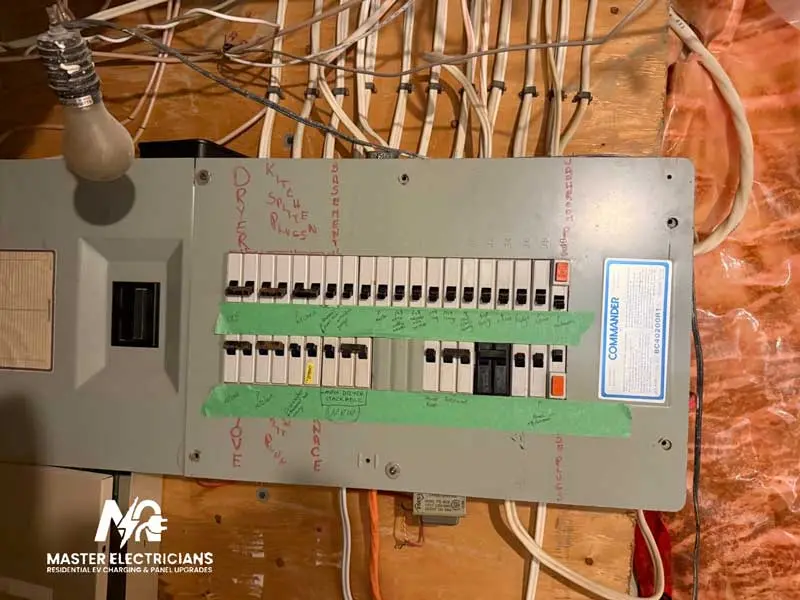
In older Toronto and GTA homes, the condition of the existing wiring can also affect the project.
Older Toronto homes may have outdated wiring, aluminum wiring or other electrical issues that can affect the scope of a panel replacement. If the existing wiring also needs attention, our home wiring and rewiring services can help address these electrical concerns.
During an inspection, an electrician may discover:
- Aluminum wiring
- Knob-and-tube wiring
- Damaged conductors
- Improper modifications
- Missing grounding
- Overloaded circuits
- Outdated connections
- Improperly sized conductors
- Previous DIY electrical work
For this reason, an electrical inspection may be recommended before replacing the fuse box.
Aluminum Wiring
Some older homes in Toronto and the GTA contain aluminum branch-circuit wiring.
It does not automatically mean the entire house needs to be rewired.
However, the condition and connections should be assessed by a qualified professional.
Knob-and-Tube Wiring
Very old homes may contain knob-and-tube wiring.
If this is present, replacing the fuse box alone may not address all of the home’s electrical safety or modernization needs.
The appropriate solution depends on the condition and extent of the existing wiring.
Why Toronto and GTA Homes Often Need Electrical Panel Upgrades
Many older homes across Toronto and surrounding GTA communities were built before today’s electrical demand became normal.
A house that once had to support:
- Basic lighting
- A refrigerator
- A few outlets
- A furnace
- Small kitchen appliances
may now need to support:
- Multiple computers
- Home offices
- Central air conditioning
- Electric ranges
- Dishwashers
- Multiple refrigerators/freezers
- Heat pumps
- EV chargers
- Hot tubs
- Basement renovations
The electrical panel is therefore often upgraded as part of a larger renovation or electrification project.
Signs Your Fuse Box May Need Replacement
An old fuse box is not necessarily failing simply because it is old.
However, these warning signs deserve professional attention:
- Frequently blown fuses
- Warm or hot panel
- Burning smell
- Buzzing or crackling
- Discolouration around fuse holders
- Flickering lights
- Frequent circuit overloads
- Limited electrical capacity
- Improvised fuse replacements
- Lack of available circuits
- Plans for major electrical additions
Never replace a fuse with a larger fuse simply because the smaller one keeps blowing.
A fuse that repeatedly blows may be indicating an overloaded circuit, wiring problem or other electrical issue.
The solution is to identify the cause rather than bypass the protection.
What Happens During a Fuse Box Replacement?
A typical project may follow these steps:
1. Electrical Assessment
The electrician evaluates the existing panel, service size, wiring, grounding and connected loads.
2. Determine the Required Capacity
The electrician selects the appropriate panel size based on current demand and planned upgrades.
3. Plan the Installation
Next, the electrician determines how to install the new panel and whether the project requires utility coordination.
4. ESA Notification
The electrical contractor submits the required notification through ESA.
5. Power Disconnection
Where necessary, the electrician safely disconnects the electrical service before starting the work.
6. Remove the Old Fuse Box
The electrician removes the existing fuse equipment.
7. Install the Breaker Panel
After that, the electrician installs the new panel and breakers, then connects the circuits.
8. Correct Electrical Issues
The electrician corrects any necessary grounding, bonding, wiring or circuit issues.
9. Label and Test Circuits
The electrician clearly labels the circuits and tests the installation.
10. Inspection and Completion
ESA completes the required inspection steps, and the homeowner receives the appropriate documentation after acceptance.
How Long Does It Take to Replace a Fuse Box?
A straightforward panel replacement can often take one day
In contrast, projects that require service upgrades, rewiring, utility coordination or additional electrical work may take longer.
However, the timeline can increase when the project includes:
- Service upgrades
- Utility coordination
- Panel relocation
- New service entrance wiring
- Grounding corrections
- Rewiring
- Difficult access
- Additional electrical repairs
For this reason, a simple panel swap and a complete 60A-to-200A service upgrade should not be treated as the same type of project.
Common Mistakes Homeowners Should Avoid
Choosing a Panel Based Only on Price
The cheapest panel or quote is not necessarily the best option.
The panel should be appropriate for the home’s electrical system and future requirements.
Assuming 200A Is Always Necessary
A larger panel is not automatically the correct solution.
The electrical load should be evaluated first.
Ignoring Existing Wiring
Installing a new breaker panel does not automatically make old wiring safe or suitable.
Existing wiring should be assessed as part of the project.
Hiring an Unlicensed Contractor
Electrical work should be performed by a properly licensed electrical contractor when you are hiring someone to do the work.
ESA provides a public registry for Licensed Electrical Contractors in Ontario.
Comparing Quotes Without Comparing Scope
One contractor’s “$2,000 panel replacement” may not include the same work as another contractor’s “$4,000 service upgrade.”
Always ask:
- What panel is included?
- What amperage is included?
- Is labour included?
- Are breakers included?
- Is grounding included?
- Is utility coordination included?
- Is ESA notification included?
- Are inspections included?
- Are additional repairs excluded?
This makes the quotes much easier to compare.
Is Replacing a Fuse Box Worth It?
For many homeowners with older electrical systems, replacing an outdated fuse box can be a worthwhile improvement.
Potential benefits include:
- Modern circuit protection
- Easier circuit reset
- Improved electrical capacity
- Better support for modern appliances
- Easier future electrical upgrades
- Cleaner circuit organization
- Better preparation for EV charging
- Improved functionality for renovations
However, a breaker panel is not automatically safer simply because it uses breakers.
The entire electrical installation still needs to be properly designed, installed and maintained.
That is why professional assessment matters.
For additional electrical needs, explore our complete range of electrical services for homes and businesses across Toronto and the GTA.
How to Get an Accurate Fuse Box Replacement Quote
Online price ranges are useful for budgeting.
But the most accurate price comes from evaluating the actual property.
Before requesting a quote, have the following information available if possible:
- Current fuse box photo
- Service amperage
- Approximate age of the home
- Location of the panel
- Number of major electrical appliances
- Planned renovations
- EV charger plans
- Heat pump plans
- Basement renovation plans
Then ask the electrician to clearly separate:
Panel replacement cost
from
Service upgrade cost
and
Additional electrical work.
Ultimately, the fuse box replacement cost depends on whether you need a simple panel replacement or a larger electrical service upgrade.
What Should You Budget for a Fuse Box Replacement in Toronto?
For planning purposes, homeowners can use these ranges:
Simple Fuse Box Replacement Cost
CAD $1,900–$3,800
Appropriate for a relatively straightforward conversion where the existing service does not require major upgrades.
Fuse Box to 200A Service
CAD $2,500–$5,500+
The cost increases when the project involves a service-capacity upgrade and additional components.
60A to 200A Service Upgrade
CAD $3,000–$5,500+
Older 60A services can require more extensive service-entrance work.
Complex Electrical Upgrade
CAD $5,000+
Projects involving significant rewiring, panel relocation, grounding problems, service entrance work or other major corrections can exceed the typical ranges.
These figures are budgeting estimates for 2026, not fixed prices. A site assessment is necessary to determine the actual scope.
Final Takeaway
The cost to replace a fuse box with a breaker panel in Toronto and the GTA can range from roughly CAD $1,900 to $3,800 for a relatively straightforward conversion.
If your home also needs a service upgrade—particularly from an older 60A or 100A service to 200A—the project can move into the CAD $3,000–$5,500+ range. More complex electrical work can push the total even higher.
The biggest mistake is assuming that every fuse box replacement is the same.
Before choosing a contractor, find out:
- What size service you currently have
- Whether the existing service can support your needs
- Whether you need 100A or 200A
- Whether the meter base or service entrance needs replacement
- Whether the existing wiring requires attention
- Whether ESA notification and inspection are included
- What exactly is included in the quote
If you’re planning to replace an outdated fuse box in Toronto or the GTA, Master Electricians can assess your existing electrical system, explain whether you need a simple panel replacement or a larger service upgrade, and provide a clear plan for the work.
Need to replace an old fuse box?
Contact Master Electricians to Get a Free Quote and discuss your home’s electrical needs and arrange a professional assessment.
Contact Master Electricians at +1 416-825-1015
Frequently Asked Questions
How much does it cost to replace a fuse box with a breaker panel in Toronto?
A straightforward fuse box-to-breaker-panel conversion can cost approximately CAD $1,900–$3,800. If the project also requires a service upgrade, the total can reach $3,000–$5,500+, depending on the home’s electrical system and installation requirements.
Does replacing a fuse box mean I need a 200A service?
Not necessarily. The required service size depends on your home’s existing electrical demand and future plans. An electrician should assess the electrical load before determining whether 100A, 200A or another configuration is appropriate.
How much does it cost to upgrade from 60A to 200A in Toronto?
A 60A-to-200A service upgrade can typically fall around CAD $3,000–$5,500+, depending on the service entrance, meter base, utility requirements, grounding and other electrical work.
Can I replace a fuse box without replacing the existing wiring?
Sometimes. Existing wiring can potentially remain if it is suitable and in acceptable condition. However, older homes may have aluminum wiring, knob-and-tube wiring, damaged conductors or other issues that require additional work.
Do I need ESA involvement when replacing a fuse box?
Electrical work of this type must be properly reported to ESA and comply with the Ontario Electrical Safety Code. When hiring a contractor, ESA recommends using a Licensed Electrical Contractor.
How long does it take to replace a fuse box with a breaker panel?
A straightforward replacement may be completed in a day. A service upgrade or project involving rewiring, utility coordination or other electrical corrections can take longer.
Is a breaker panel safer than an old fuse box?
A properly installed modern breaker panel can provide modern circuit protection and easier circuit management, but simply replacing the box does not resolve every electrical safety issue. The existing wiring, grounding and overall electrical system should also be assessed.
Sources & Pricing References
The pricing ranges in this guide are estimated 2026 Toronto and GTA market ranges. Actual costs can vary depending on the existing service size, panel location, wiring condition, utility requirements and the scope of work.
For electrical notification and inspection requirements in Ontario, homeowners can refer to the Electrical Safety Authority (ESA) for official information.
These price ranges are intended as a practical budgeting guide rather than a fixed quote. A licensed electrical contractor should assess the existing electrical system before providing a final price.
