Electrical Emergency at Home: What to Do Before the Electrician Arrives

If there’s a fire, smoke, or someone has been badly shocked, call 911 first. Don’t stay inside trying to figure out the electrical problem.
Other electrical problems call for different responses, depending on what you see and smell. A burning odour, a sparking outlet, a buzzing panel, a breaker that keeps tripping, or water near anything electrical can all mean you need to act quickly.
The order of priorities is straightforward: look after people first, don’t make things worse, and only shut off the power if you can do it safely.
This guide covers how to recognize an electrical emergency, when to call 911, when to call an emergency electrician, and what you can safely do while you wait for help.
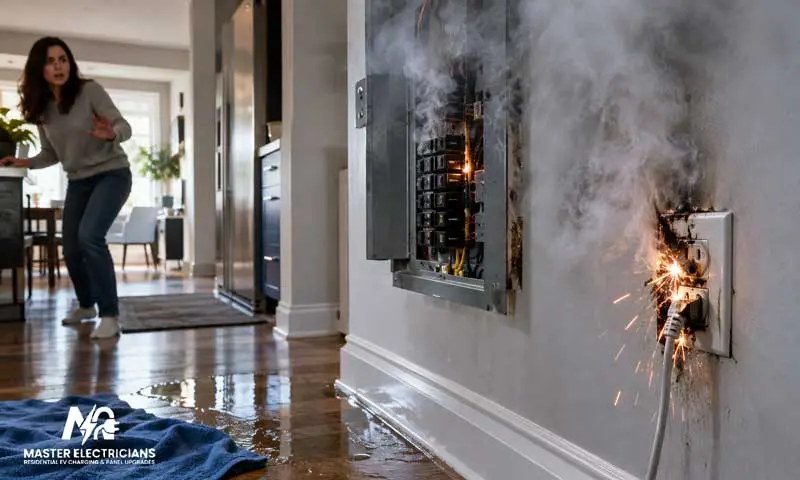
Quick Electrical Emergency Triage
Not every electrical problem needs the same response. Here’s a quick way to sort out where yours falls.
| Situation | What to Do |
|---|---|
| Fire, smoke, electric shock, downed power line, or anyone in immediate danger | Get out of the area and call 911. |
| Burning smell, sparking outlet, buzzing panel, overheating equipment, or serious water exposure | Keep away from the hazard, shut off power only if it’s clearly safe, and call a licensed electrician. |
| An occasional breaker trip, a flickering light, or a dead outlet with no heat or burning smell | Don’t keep resetting the breaker. Book an electrician to inspect or repair it. |
If you’re not sure which category you’re in, play it safe and stay away from the equipment.
What Counts as an Electrical Emergency?
An electrical emergency is a situation where an electrical problem could cause a fire, electric shock, serious injury, or significant property damage if it isn’t dealt with promptly.
Some cases are obvious, like flames or a live wire hanging out of a wall. Others start out quieter, such as a faint burning smell from an outlet or a breaker that trips again and again.
Signs You Should Call 911
Call 911 if someone’s life may be at risk or there’s a fire, including when you see:
- An electrical fire or visible flames
- Heavy smoke coming from an outlet, appliance, wall, or electrical panel
- Someone who has had a serious electric shock
- A person who is unconscious, hurt, or in danger after an electrical incident
- A downed power line or damaged equipment that puts people nearby at risk
- Arcing or sparking where there’s also flooding or standing water and people could be exposed
If there’s an active fire or immediate danger, don’t wait for an electrician to show up before you call 911.
Signs You Should Call an Electrician Urgently
Some situations don’t need 911 but still shouldn’t wait:
- A burning smell from an outlet, switch, appliance, or panel
- An outlet or switch that’s hot, discoloured, melted, or visibly damaged
- Breakers that trip repeatedly
- Buzzing, crackling, or sizzling sounds that don’t go away
- Sparks from an outlet or other electrical equipment
- Part of the house losing power for no obvious reason, with no utility outage in the area
- Electrical equipment that has gotten wet
- A breaker that trips the moment you reset it
Symptoms like these can point to an underlying electrical problem, so don’t ignore them.
Problems That Can Usually Wait for a Scheduled Visit
Some issues are worrying but aren’t emergencies, as long as there’s no heat, smoke, burning smell, water, or risk of shock. For example:
- A breaker that trips once in a while
- One light that flickers
- A dead outlet with no burning smell or visible damage
- An older component that still works normally
- A light fixture that cuts out now and then
Even so, a problem that keeps coming back should be looked at by a professional. Resetting it over and over, or ignoring it, isn’t a fix.
When to Call 911 Instead of Waiting for an Electrician
Electricians can repair electrical faults, but in some situations Emergency Electrician services have to come first.
Electrical Fire or Smoke
If an outlet, appliance, panel, or wiring is smoking or burning:
- Get everyone away from the danger.
- Call 911.
- Don’t try to find the source of the fire.
- Don’t touch the electrical equipment.
- Stay out until emergency responders tell you it’s safe.
Don’t assume a small electrical fire is something you can handle. The equipment may still be energized, and the fire can spread inside walls and other hidden spaces.
Electric Shock
If someone has been shocked, don’t touch them if they might still be in contact with the source of the electricity.
Step away from the hazard and call 911. Don’t try to pull the person free with your hands.
Once the power source has been safely disconnected and the person is out of danger, do what the emergency responders tell you.
Downed Power Lines
Treat every downed line as live and dangerous.
Stay well back and keep other people away too. Toronto Hydro currently advises staying at least 10 metres away from a downed or damaged line and calling them right away to report the hazard. If people or property are in immediate danger, call 911 first.
Don’t touch a fallen wire, or anything near it that could be energized, such as a fence or a vehicle.
Electricity and Water
Water and electricity are a bad mix.
If outlets, wiring, a panel, or other electrical equipment have been exposed to flooding or a lot of water, keep away from the area.
Don’t walk into a flooded space where electrical equipment might still be live. If anyone is at immediate risk, get out and call 911.
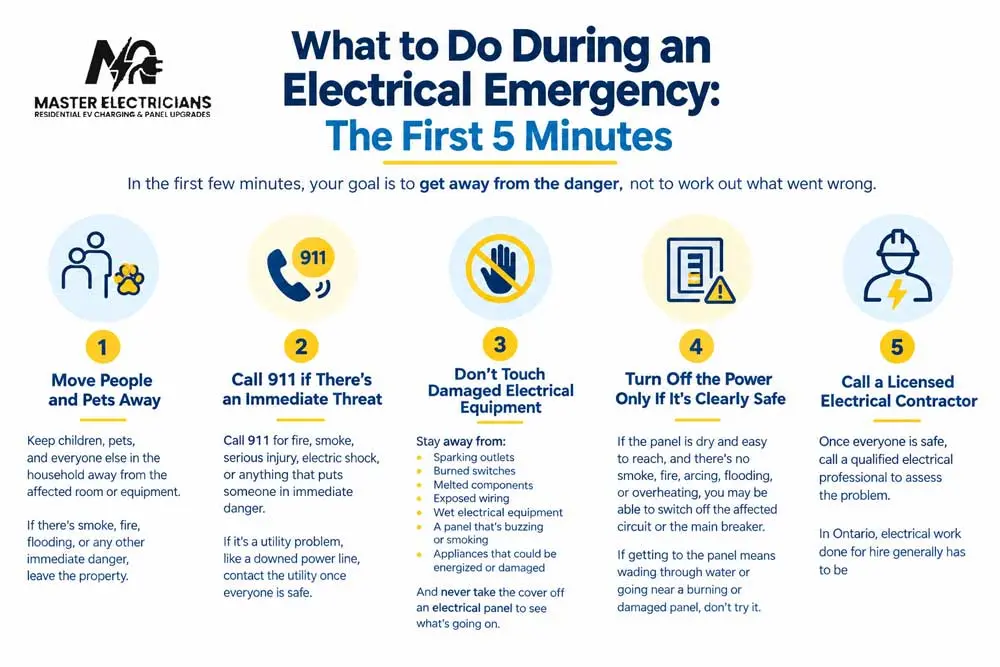
What to Do During an Electrical Emergency: The First 5 Minutes
In the first few minutes, your goal is to get away from the danger, not to work out what went wrong.
1. Move People and Pets Away
Keep children, pets, and everyone else in the household away from the affected room or equipment.
If there’s smoke, fire, flooding, or any other immediate danger, leave the property.
2. Call 911 if There’s an Immediate Threat
Call 911 for fire, smoke, serious injury, electric shock, or anything that puts someone in immediate danger.
If it’s a utility problem, like a downed power line, contact the utility once everyone is safe.
3. Don’t Touch Damaged Electrical Equipment
Stay away from:
- Sparking outlets
- Burned switches
- Melted components
- Exposed wiring
- Wet electrical equipment
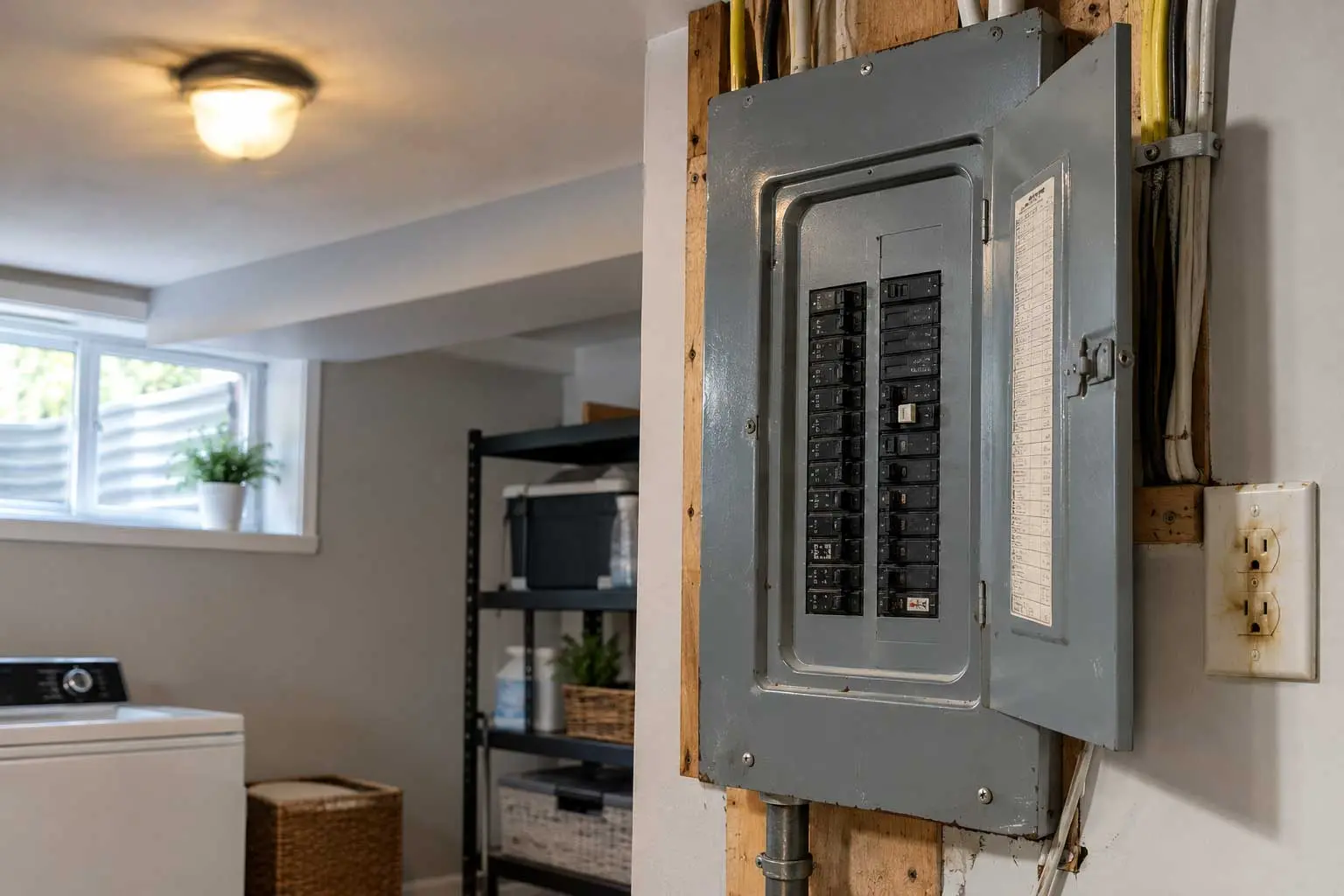
- A panel that’s buzzing or smoking
- Appliances that could be energized or damaged
And never take the cover off an electrical panel to see what’s going on.
4. Turn Off the Power Only If It’s Clearly Safe
If the panel is dry and easy to reach, and there’s no smoke, fire, arcing, flooding, or overheating, you may be able to switch off the affected circuit or the main breaker.
If getting to the panel means wading through water or going near a burning or damaged panel, don’t try it.
5. Call a Licensed Electrical Contractor
Once everyone is safe, call a qualified electrical professional to assess the problem.
In Ontario, electrical work done for hire generally has to be carried out by a Licensed Electrical Contractor (LEC), with some exemptions. ESA recommends checking the contractor’s ECRA/ESA licence before you hire.
When Is It Safe to Turn Off the Power?
Cutting the power can limit further damage, but in some emergencies, just getting to the panel is dangerous.
It’s generally reasonable to shut off the power when:
- The panel is completely dry
- There’s no flooding around it
- Your hands and clothing are dry
- There’s no smoke or visible fire
- The panel isn’t hot
- You can’t see any arcing or sparking
- You can reach it without passing through a hazardous area
Do not go near the panel if:
- There’s water around it or inside it
- A water leak is coming from directly above it
- The panel is smoking or visibly damaged
- You can hear heavy buzzing, crackling, or arcing
- There’s a strong burning smell coming from it
- You’re not sure it’s safe
Never remove the panel cover during an emergency.
If a breaker keeps tripping, stop resetting it. Toronto Hydro specifically advises that a breaker tripping again after a reset may signal a more serious problem, and that you should call a qualified electrician.
Electrical Problems You Should Never Try to Fix Yourself
An emergency is a bad time to try a DIY repair.
Don’t try to repair or modify any of these:
- Burned outlets or switches
- Damaged electrical panels
- Exposed wiring
- Breakers that keep tripping
- Water-damaged electrical equipment
- Melted components
- Wiring you don’t recognize or that’s damaged
- Electrical service equipment
- Anything that means opening the panel
Ontario homeowners can perform certain electrical work themselves under specific rules and requirements. Still, electrical work is complicated and dangerous, and it has to follow the Ontario Electrical Safety Code. If you hire someone, ESA says that person must be a Licensed Electrical Contractor.
When the problem involves fire, shock, overheating, water damage, or faults that keep coming back, it’s safer to have a professional assess it.
What to Do While Waiting for an Emergency Electrician
Once the immediate danger is dealt with, the goal is to keep the area safe until help arrives.
Keep Everyone Away From the Problem
Don’t let children, pets, or other household members into the affected area.
Use Flashlights Instead of Candles
If the power’s out, use a flashlight where you can. An open flame is a bad idea in a home that may have an electrical fault.
Unplug Equipment Only If It’s Safe
If an appliance or device is dry, undamaged, and easy to reach, unplugging it can help prevent further trouble.
Leave anything alone that’s wet, sparking, smoking, hot, or damaged.
Don’t Use a Generator Indoors
Never run a fuel-burning generator inside your house, garage, or shed.
Health Canada recommends running generators outdoors, at least 6 metres (20 feet) from buildings, with the exhaust pointed away from doors and windows.
Keep the Panel Accessible
If the panel is safe and the area isn’t hazardous, clear the way so the electrician can get to it quickly.
Document What Happened
If it’s safe to do so, take photos or make a note of:
- Which breaker tripped
- Which outlets or rooms lost power
- When the problem started
- Any unusual smell or sound
- Whether an appliance was running when it happened
- Whether water or weather played a part
These details can help the electrician understand what happened.
Common Electrical Emergencies in Toronto Homes
Electrical emergencies can happen in older and newer homes alike.
Older Electrical Systems
Older homes may have aging panels, outdated wiring, limited capacity, or years of modifications layered on top of each other.
Watch for repeated breaker trips, warm outlets, flickering lights, buzzing, and burning smells, and don’t ignore them.
If you’re worried about the state of your home’s electrical system, a safety inspection can turn up hazards before they turn into emergencies.
Older homes may also have outdated fuse boxes that should be assessed by a licensed electrician. If the system is outdated or no longer suitable for the home’s electrical demand, fuse box replacement may be recommended.
Basement Flooding and Water Damage
Heavy rain, plumbing failures, and flooding can leave electrical equipment wet.
Don’t assume the system is safe just because the water has gone down. Moisture can stay inside electrical components and cause hazards long after the visible flooding is gone.
Storms and Power Outages
Toronto gets weather that can knock out power in one neighbourhood or across a wide area.
Toronto Hydro says outages can come from weather, equipment failures, wildlife, and other outside causes. If only part of your home has lost power, the fault may be inside the house rather than a wider outage.
If your neighbours still have power and only part of your home is out, the problem may be inside your home’s electrical system and should be checked by an electrician.
Increased Electrical Demand
Homes today use more electrical equipment than many older systems were built for.
EV charger installation, electric heating, home offices, kitchen appliances, hot tubs, and other high-demand equipment can put extra load on your home’s electrical system.
If you’re planning a major electrical addition, such as an EV charger or high-demand appliance, have the existing system evaluated first. In some cases, an electrical panel upgrade may be needed to safely handle the additional load.
If you’re planning a major electrical addition, have the existing system evaluated first instead of assuming it can handle the load.
How to Prevent Future Electrical Emergencies
The best time to deal with an electrical problem is before it becomes an emergency.
Watch for early warning signs like:
- Frequent breaker trips
- Lights that flicker or dim
- Warm or discoloured outlets
- Burning smells
- Buzzing or crackling sounds
- Damaged cords
- Loose outlets
- Exposed wiring
- Water getting in near electrical equipment
It also helps to:
- Keep panels accessible
- Avoid overloading outlets
- Replace damaged cords and plugs
- Test GFCI devices as recommended
- Keep electrical equipment away from water
- Have any major electrical changes assessed by a professional
- Deal with recurring problems instead of resetting breakers again and again
In homes with older electrical systems, a professional safety assessment can catch problems that a regular visual check would miss.
When to Call a Licensed Electrician
Not every electrical problem is an emergency, but warning signs that keep repeating shouldn’t be ignored.
Call a licensed electrical contractor if you notice:
- Breakers that trip repeatedly
- Lights that keep flickering
- Burning smells
- Buzzing or crackling
- Warm outlets or switches
- Electrical equipment damaged by water
- An outlet that sparks
- Partial power loss you can’t explain
- Problems that started after a renovation or new electrical installation
If there’s a fire, smoke, a serious electric shock, or anyone in immediate danger, call 911 first.
For electrical hazards that aren’t fires, and for urgent faults, a licensed professional can assess the system and work out what repairs or further investigation it needs.
ESA recommends verifying the contractor’s ECRA/ESA licence when you hire someone for electrical work in Ontario.
If you’re unsure what to look for when hiring one, our guide explains how to hire a licensed electrician in Toronto and the GTA.

Frequently Asked Questions
Is a tripped breaker an electrical emergency?
Not necessarily. A breaker can trip from an overload or from some other fault. If it happens once and you know the cause, it may not be an emergency. But if it trips repeatedly, trips right after you reset it, or comes with heat, a burning smell, buzzing, or sparks, stop resetting it and call a qualified electrician.
What should I do if an outlet is sparking or smells like burning?
Stop using it and keep away from it. If there’s smoke, fire, or immediate danger, leave the area and call 911. If there’s no immediate threat, shut off the circuit only if you can reach the panel safely, then call a licensed electrical contractor.
Can I call an electrician instead of 911 for an electrical fire?
No. If there’s an active electrical fire, heavy smoke, or an immediate threat to anyone, call 911 first. The electrician can deal with the electrical system after the emergency itself has been handled.
Is it safe to reset a breaker that keeps tripping?
No, you shouldn’t keep resetting a breaker that keeps tripping. Repeated trips can point to an overload, a fault, or another electrical problem. Toronto Hydro advises calling a qualified electrician if a breaker trips again after you reset it.
Should I unplug appliances during an electrical problem?
Only if the equipment is dry, undamaged, and safe to reach. Don’t touch or unplug anything that’s wet, sparking, smoking, hot, or visibly damaged.
In an electrical emergency, the order of priorities is simple: protect people, stay away from the hazard, call 911 if there’s an immediate threat, and only shut off the power when it’s clearly safe.
Burning smells, sparking outlets, breakers that keep tripping, buzzing panels, water exposure, and damaged equipment should never be ignored.
If it isn’t a 911 emergency but you need professional help, call a Licensed Electrical Contractor who can safely assess your electrical system and recommend next steps.
If you’re dealing with an electrical problem that can’t safely wait, Master Electricians provides professional electrical services for homeowners across Toronto and the GTA.